
Echoing Prime Minister Narendra Modi's views that improving the health of financial markets alone cannot fuel growth, G20 business leaders on Friday said vigorous efforts should be made to go beyond fiscal and monetary policy to kickstart world economy and create jobs.

How do we get back to higher trend growth? The heart of the problem lies in private corporate investment, recommends Ajay Shah.
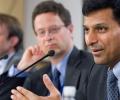
RBI projects GDP growth in FY16 at 7.8 per cent, 30 bps higher than FY15. However, this comes with a downward bias.

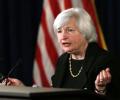
The Fed made clear that the rate hike was a tentative beginning to a "gradual" tightening cycle
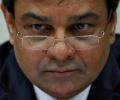
Patel, 55, who took over as the 24th Governor of the central bank on September 5, 2016, had the shortest tenure since 1992.

To spur foreign investment in the corporate bond market, the Finance Ministry has proposed reduction in withholding tax for FIIs to 5 per cent, from 20 per cent at present.
The RBI's projections for consumer inflation over the rest of the year indicate some acceleration, with the rate reaching eight per cent in its baseline scenario.

Heading to the third year, will Urjit Patel be busy firefighting a currency crisis? Almost no governor of the RBI managed to evade it and Patel perhaps knows it.
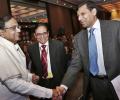
"We did not abuse RBI governors," says Chidambaram.

With the industrial production dragging the overall growth down, it said the government must also focus on the manufacturing sector by reducing the "infrastructure deficit".

The 30-share Sensex jumped 729 points to end at 28,076 and the 50-share Nifty soared 217 points to end at 8,494.

Prime Minister Narendra Modi will push for stepping up global cooperation against the key issue of cross border tax avoidance and evasion at the G20 summit

A two-year extension at the helm of the RBI still looks a real possibility

Ajay Banga was on Wednesday appointed the next president of the World Bank, becoming the first-ever Indian-American to head the global financial institution which said it looks forward to working with him at a time when it's tackling the toughest development challenges facing developing countries. "The executive directors of the World Bank today selected Ajay Banga as president of the World Bank for a five-year term beginning June 2, 2023," the bank said in a press statement. In February, President Joe Biden announced that the US would be nominating Banga, 63, to lead the World Bank because he is "well equipped" to lead the global institution at "this critical moment in history."

With the Budget-making exercise in full swing, RBI Governor Shaktikanta Das on Friday said Budget 2021-22 is expected to be prudent and growth oriented. Das before donning the hat of RBI Governor was a career bureaucrat and was directly involved in crafting of about 10 Budgets for the country including one in the aftermath of global financial meltdown in different capacities at the finance ministry. In view of unprecedented pandemic and its impact on the economy, he said the government has maintained fiscal prudence in the response to deal with the crisis.

Finance Minister Arun Jaitley said RBI and the government are in continuous dialogue and that relationship will continue.

'It could backfire on the BJP and boost the Opposition parties.'
The RBI had lowered policy rates by 0.50 per cent between January-March to prop up economic growth.

Kakar, a lawmaker belonging to Balochistan Awami Party (BAP), will lead a caretaker government until a new election later this year.

The council wants the government to stick to its fiscal consolidation road map.

You don't prep for 2028 but for 2040, or even 2044. Sustained sporting excellence is based on mass support, grassroots development, and funding - and it is this trifecta India needs to work on, systematically, asserts Prem Panicker.
The statement, issued after the 2-day meeting of the 6-member Monetary Policy Committee of the Reserve Bank of India, also said that recapitalisation of public sector banks along with resolution of stressed assets under the Insolvency and Bankruptcy Code (IBC) will create demand for fresh investments.

At the same time, however, officials at the central bank lowered their projections for the long-run target interest rate, evidence of slightly diminished expectations for a nation climbing out of a severe crisis and struggling with demographic headwinds like declining labor force participation.

Despite admitting to price pressures both from food items and input prices, RBI Governor Shaktikanta Das on Wednesday hoped that a normal Southwest monsoon will have a "soothing impact" on inflation pressures and ruled out any wide variations in medium-term inflation forecast from what was given in April. In an unscheduled address earlier in the day amidst the raging pandemic, Das said the overall outlook for the economy is highly uncertain and is clouded with downside risks. He offered a slew of relief and liquidity measures to individuals and small businesses apart from a Rs 50,000 crore special liquidity window to the healthcare sector.
CREDAI Chairman Lalit Jain said a long term status quo on interest rates would not help prospective home buyers.

Rajan retained the short-term lending rate at 6.5 and the cash reserve requirement of banks at 4 per cent.

The World Bank has appointed Indermit Gill, an Indian national, chief economist and senior vice-president for development economics at the multilateral development bank. "Indermit Gill brings to this role a combination of leadership, invaluable expertise and practical experience working with country governments on macroeconomic imbalances, growth, poverty, institutions, conflict, and climate change," World Bank President David Malpass said in a statement. His appointment will be effective September 1, 2022.
Broader market outperformed with the S&P BSE Midcap index adding 0.7%, while S&P BSE Smallcap index gained 0.6%.

India's exports remained in the negative territory for the 11th month in a row.

The rupee is expected to remain under pressure in the near term, given the strengthening of the dollar against major global currencies and widening of the trade deficit.

The speed at which he led the central bank in different areas -- ranging from internal reorganisation to inflation fighting, stabilising the currency, taking on rogue corporations, cleaning up bank balance sheets, and opening the sector -- makes one believe that Rajan knew he had only three years to do his job. A fascinating excerpt from Tamal Bandyopadhyay's MUST-READ Roller Coaster: An Affair with Banking.
As a result, the forecast of eight per cent retail inflation by January next year looks achievable.
Head of state-run Indian Bank T M Bhasin had called for a CRR cut.

The new Chief Economic Advisor Krishnamurthy Subramanian believes that more than unemployment, it is the quality of employment which needs to be focused on. In an interview with Arup Roychoudhury and Indivjal Dhasmana, Subramanian said that controlling inflation was the Modi government's biggest achievement.
Media has gone beyond its traditional boundaries.

RBI had asked banks to price fixed rate loans of up to three years based on marginal cost of funds from April 1

The International Monetary Fund (IMF) warned on Tuesday that India's general government debt (comprising both central and state government debt) could exceed 100 per cent of gross domestic product (GDP) in the medium term. It also cautioned that long-term debt sustainability risks are high due to the significant investment required to meet India's climate change mitigation targets. The Indian government, however, disagreed, arguing that risks from sovereign debt are extremely limited as it is predominantly denominated in domestic currency.

The report said that "we believe, institutions are more important than individuals" and ultimately what is important is the credibility and the independence of any institution and nothing else.

If you are one among the millions of existing borrowers who are paying a higher interest rate compared to new borrowers of the same bank, make your shift now, before prepayment charges make it more expensive.
